Monday, July 31, 2006

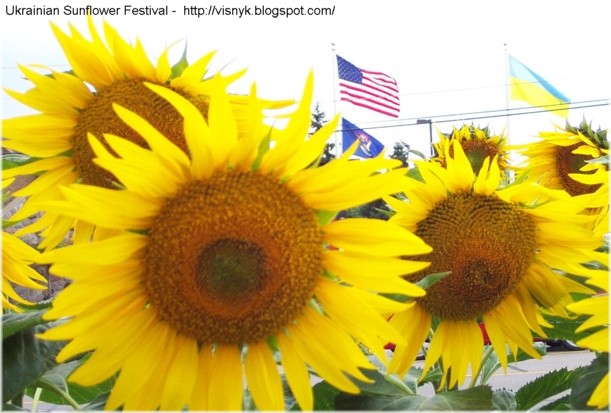
Ukrainian Sunflower Festival Photos


~:~

~:~
Photos from the 2004 festivities in Warren, MI
Wednesday, July 26, 2006

Ukrainian Sunflower Festival of Detroit, Aug. 25 - 27, 2006

Looking for a fun Ukrainian-American festival this summer? Consider the 20th annual Sunflower Festival to be held Aug 25 - 27, 2006 on the St Josaphat Church grounds on Ryan road in Warren, Michigan.

My relatives always enjoys the activites of the festival including live music, dancing, traditional craft demonstrations, and lots and lots of fresh Ukrainian food - varenyky, holubsti, kovbasa, tortes, etc. all made and served by women of the community. There are also rides and games for kids, bingo for the older folks, and Ukie kitsch for all.

I hope to hear the local Detroit band the Polish Muslims play their brand of funky ethno-folk-rock. I have not seen them in years. I'm also interested in hearing Ephyra, a Ukrainian-American rock band from Chicago. According to the band's web site, their "sound is one that consists of modern, progressive rock with a flavor of traditional Ukrainian influence." Could be good!

For a full festival schedule and entertainment line-up, check out the official Sunflower Festival web site.

Thursday, July 13, 2006

Wonderful Photos of Ukraine #1

Stefan, who writes the blog Dykun, has some wonderful photos posted of a modern Hutsul wedding. (I think the photo of the trio is stunning.) Take a peek. Check farther down in his blog and in the archives for some authentic video of traditional village work.

Monday, June 26, 2006

Marriage Records Found: Family History 2

I started doing family research a number of years before the big Internet boom when every organization starting putting up web sites and "dot-com" was not commonly seen on the sides of trucks or on billboards. Looking back over these years, it amazes me at how much the Internet has impacted the work of genealogists. I have a few personal stories. Here is the latest:

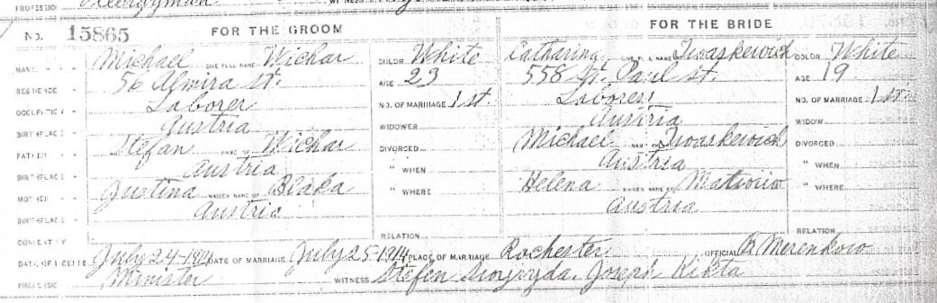
2 pairs of my great-grandparents were immigrants from Ukraine (then part of the Austro-Hungarian Empire). They got married in the New World near the beginning of the 20th Century. I've known the cities where they were married for quite some time, but for some reason, never contacted those municipalities about getting copies of their marriage records, which never had. It turns out that both areas have searchable indexes of older marriages online (Rochester, NY : Manitoba, Canada). Quite easily I was able to find references for both marriages. I printed out the online forms, wrote checks, and sent away for copies of both records. Just the other day I was delighted to receive a marriage record in the mail from Rochester, NY! What a nice feeling to add a few missing pieces to the family history puzzle.
Here's the document that I received:

Friday, June 23, 2006

Family History 1


I'm really into researching my family history. I'll start documenting some of the research I've done on my Ukrainian side.

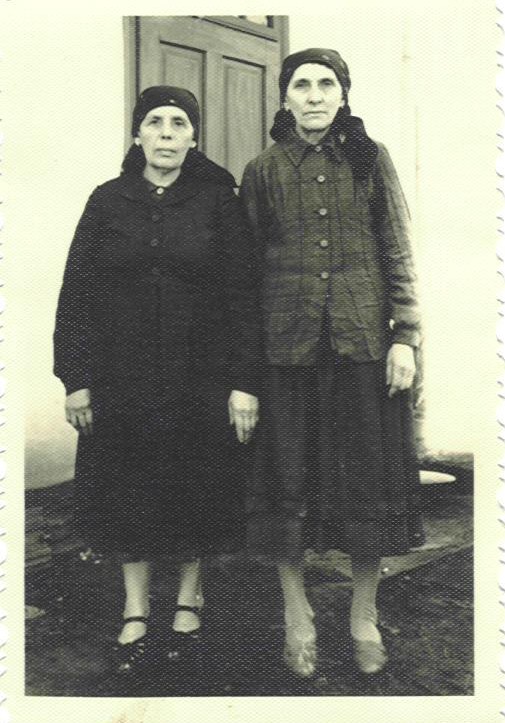
My great Anna Yanyk, who was a 1913 teenaged immigrant from Ukraine to Canada (and then the US), wrote letters back and forth to her sister Donya and a friend in her home village. My family is thankful to have about 10 of the letters she received, mostly from the 1960s. No one knows when she started writing letters or even that she was staying in touch with relatives in Ukraine. Anna died in 1969. Letters were in a trunk among other articles like her green card, her school report card and baptism paper, and my great-grandpa's straight razor and eyeglasses.

This photo was sent from Ukraine in 1965 to Anna Sokoliuk (nee Yanyk) in Detroit. Nastya Korolik, standing on the left, was the letter writer. "Big Marina" is on the right. Both were neighbors from Anna's home village.

Wednesday, June 21, 2006

Ukrainian American Archives & Museum of Detroit

I was doing some research on Chornobyl recently and ended up with a link to the freshly updated web site of the Ukrainian American Archives & Museum of Detroit. Wow, nicely designed web site from an institution in my own backyard. Living in the area, I have always known about UAAMD and have visited there, but it seemed like there was not much happening at that time (over 10 years ago). Now, things are happening (classes, exhibits, oral histories collected, demostrations, etc.) and the Museum/Archive is outgrowing its HQ. Hoping I could help with the mission, "to educate and inform the general public about the culture, art, and history of Ukrainians, their immigration to the United States and the contributions of Americans of Ukrainian descent to America..." I decided to join. I hope to assist with digitizing historic photos and getting them online for others to view and learn from.

Thursday, May 04, 2006

BOOK: When Luba Leaves Home by Irene Zabytko


I recently picked up a copy of and I’m really enjoying reading When Luba Leaves Home, a series of 10 connected short stories written by Irene Zabytko, published in 2003. I’ve just finished reading the sixth story titled, Obligation. All of the stories are narrated by the central character, Luba, a Ukrainian in her early twenties of the post-WWII displaced persons (DP) group of immigrants who lives with her parents in Chicago’s Ukrainian Village and goes to a nearby university. Luba struggles in her desires to become an American woman while retaining her Ukrainian identity. When visiting another immigrant friend's apartment, Luba remarks, "She had a few Ukrainian embroidered pillows but little else from the Old Country."
The collection takes place in the 1970s, and I’m guessing, may be somewhat autobiographical. All of the 6 stories that I’ve read compelled me to finish reading them in different ways. They all involve Luba & also bring in an assortment of other neighborhood characters so efficiently that as I’m reading, I feel like I’m there in the corner of the apartment or tavern, watching and listening on the periphery of the action. Has anyone else read this book or Zabytko's other book, The Sky Unwashed, which takes place in Chornobyl just after the disaster?

Other reviews of When Luba Leaves Home:
~ Blogger: Pete Lit
~ RebeccaReads.com book review
~ Ukrainian Weekly, August 31, 2003, No. 35, Vol. LXXI

Tuesday, April 11, 2006

Free Online English-Ukrainian Dictionary (Express)

My Ukrainian language skills are marginal, but I'm always learning, just not as fast as I'd like. I'm constantly on the lookout for good books, websites, or software. Here's a free English-Ukrainian online dictionary that I like and use frequently. When I get letters from Ukraine that I'm trying to translate, sometimes I use the sister site: Ukrainian-English dictionary which includes a virtual keyboard to input Cyrillic letters if you don't have them on your computer. Thanks CyberMova! Anyone else have some good Ukrainian language resources to share?

Monday, April 03, 2006

Travel books about Ukraine

(These reviews are of 2 of the travel books that I read before my summer 2005 journey to Ukraine with my mom. It was my her first trip there and my second.)


One of my favorite travel books about Ukraine is Ukraine: The Bradt Travel Guide by Andrew Evans, published by UK's Bradt in spring 2004. The first 5 chapters of the guide provides readers with an overview of the country, some info on Ukraine's turbulent history, culture, etc. I feel these chapters are quite insightful.

Starting with chapter 6 up to chapter 15, the guide moves through travel in different regions of Ukraine - from Kyiv to the Black Sea to Donbas to Galicia. Each chapter gives a little background, offers suggestions for sights, activities, attractions, places to eat, sleep, etc.

The guide wraps up with some suggested reading and a somewhat limited language section. In my opinion, this book is well worth its price for those people planning a trip to this beautiful country.

Another travel book I purchased was Let's Go: Eastern Europe. This expanded 2005 edition includes a new 52-page section about Ukraine by Aaron Litvin. (The total length of the travel guidebook is 974 pages.)

I previewed the book in a brick and mortar store, and later purchased it from an online retailer. Keeping in mind the fact that you can't write much about a huge country in 52 pages, after a few minutes of carefully reading the chapter about Ukraine, I knew I'd be disappointed. Here are a couple of my reasons why:

The back of the book includes a section called the "Glossary" that provides transcriptions, words and phrases for the languages spoken by the peoples of the countries in the guidebook. For some reason, Ukrainian is not included!! What is up with this? Lets see... according to the CIA World Factbook, Ukraine has about 47.4 million people, 67% of whom speak Ukrainian, that's about 31.7 million Ukrainian speakers in Ukraine alone! This is about as many people in Romania and Hungary who speak Romanian and Hungarian (Magyar) combined. Those languages each have their own glossaries. (BTW, Belarusian isn't included either.)

Each country in Let's Go: Eastern Europe has a section written about its food and drink. The chapter on Ukraine includes "bread," transliterated as "hlib" in the text, followed by the Cyrillic spelling. The problem is that the first letter of word for bread is written with the wrong Cyrillic character. The word that Let's Go printed isn't even an actual word. The same problem occurs with the Ukrainian word for vegetables - incorrectly spelled with Cyrillic characters. Typos or poor fact checking?

Wednesday, February 15, 2006

Peace Corps Volunteers in Ukraine

I am fascinated by the writings of Peace Corps volunteers in Ukraine. From my experience, these US citizens usually provide unique and honest perspectives on Ukraine. From Ukraine with Love is a blog by Peace Corps-teacher Christopher that I just started reading. I would also suggest a book titled Singing on the Heavy Side of the World. More on that later.

Monday, February 13, 2006

UKRAINIAN INSTITUTE OF MODERN ART

An anonymous reader suggested that people check out the Ukrainian Institute of Modern Art web site. They currently have a special exhibit titled Artist Respond: Ukrainian Art and the Orange Revolution, but hurry, it ends Feb. 28, 2006. From a UIAM press release:
  • We are pleased to announce that The Ukrainian Institute of Modern Art (UIMA) has joined together with the Center for Contemporary Art in Kiev to bring this exhibition of revolutionary art to Chicago. In December 2005, UIMA will present "Artists Respond: Ukrainian Art and The Orange Revolution" - the first exhibition of Ukrainian Revolutionary art shown in North America.
UIAM looks like another Chicago gem. This reminds me that while I was in Kyiv this past summer, some students set up some of their Orange Rev art on Miadan. I'll do some edits soon and post a photo or two.

Ukrainian Orthodox Church of St. Andrew in Boston

Fellow blogger inter_obriy left a comment to share info on St. Andrew's Ukrainian Orthodox Church in Boston. Their about us page provides some interesting history about early Ukrainian immigrants in Boston at the beginning of the 20th century, the organization of their church, and the post-WWII immigrants. The nifty Church calendar even provides RSS feed. How's that for a Church embracing technology? Thanks for the note Inter_obriy !

Sunday, October 23, 2005

Clarification on 2 churches in Chicago's Ukr. Village

According reader to ksenia, here is the correct information on the Ukrainian churches mentioned in my post from April 2005.

"Both churches are Ukrainian Catholic (Greek/Byzantine rite). St. Nicholas follows the new calendar while Sts. Volodymyr and Olha follows the old calendar and old Ukrainian traditions."

Thank you ksenia!

Sunday, July 17, 2005

Among the Russians: Book by Colin Thubron

In Among the Russians journalist Colin Thubron, a master of the English language, describes areas and people of the western Soviet Union that he observed during his 10,000 mile auto journey in 1980. Images from his lens are clearly and poetically painted. I am enjoying this read, but I do have reservations about the way Thubron clumps things of significance only to Russians or "Mother Russia" as opposed to other ethnic groups or states.
In the last chapter he quotes Kiev (not Kyiv) as being the 'Mother of all Russian cities,' and goes on to write, "From the ninth to the twelfth centuries it was the heart of a Russia which flowered in the sunlight of Byzantium, standing where the Dnieper headwaters gathered the Viking traffic before flooding south united to the Black Sea." Of course he is writing about the state of Kyivan Rus', but he fails to draw any distinction between the Eastern Slavic tribes inhabiting the region at this time in history. They were not just Russians. I am not an expert on Kyivan Rus', Russia, or the Soviet Union, but I believe Thubron does readers an injustice by over-simplfying parts of his book. Even non-experts can and should understand that Rus' and Russia are not synonyms.

For more information about Kyivan Rus' read this article at the Encyclopedia of Ukraine web site.

Friday, April 29, 2005

Radio Ukraine International

I first found out about Radio Ukraine International by scanning some station listings in an obscure radio magazine. The next evening I turned on my small Grundig shortwave radio and tried to tune into the station during the English language broadcast time. No luck. I could not even dial the frequency on my radio, so I did a search online and found the Radio Ukraine International website. No need for the shortwave radio with the power of the Internet because the station constantly streams its audio signal over the Internet. Streaming audio allows anyone in the world with a computer that can access the Internet (and who has a piece of free software, in this case, basic RealPlayer) to listen to the broadcast as it is happening. This even surpasses the power of shortwave radio broadcasts because usually shortwave signals are only broadcasted to a certian area of the world at certain times. Audio that is streamed over the Internet is available to EVERYONE, EVERYWHERE all day and all night long. Awesome! So, whether you are fluent in Ukrainian and want the lastest news directly from Ukraine, are practicing your language comprehension skills, or want to hear objective news in English - start listening! It's free!

Thursday, April 14, 2005

Гайдамаки (Haidamaky) A band creating unique Ukrainian music

Take two parts traditional Ukrainian folk music, add 1 part rock-n-roll, then 1 part ska: mix well and you’ve got a musical stew something close to Haidamaky. Of course, combining traditional with modern music is not a novel idea. The ethno-rock approach has been successfully employed by Irish and Scottish bands for years and years. Think of groups like Wolfstone, Great Big Sea, The Pogues, or Flogging Molly, but throw a Ukie spin on the sound. Intrigued? I was. Yes, England’s The Ukrainians have used a similar musical combination, but Haidamaky have added the element of ska, and somehow, it works. A year or so ago I purchased the group’s self titled, 2002 CD - Haidamaky. I was challenged but not disappointed. The disc contains 12 songs of varying tempo. Whether you’re fluent in Ukrainian or not, each song blends a variety of instruments to create its own sense of energy to pass along emotions to the listener. (You can read English translations of the lyrics on the Haidamaky web site.)

Some of the instruments played by the members of the band include:
Accordion
Drums
Drymba (jaw harp)
Electric bass
Guitar
Sopilka (traditional flute)
Trombone
Tsymbaly (hammered dulcimer)
Voice

I get a combination of playful, yet somber feelings when listening the disc. Стара Румунія (Ancient Romania) begins with a quickly walking tsymbaly line laced with trombone. The opening sequence does remind me of something from a Tarif de Haidouks disc. Two third of the way through, an organ solo speeds up the song even more to reach a frantic pace that leads to the crescendo. A cheerful melody played on sopilka opens the song КарпатенSKA (KarptenSka), but soon trombone and accordion are added and it becomes a rockin’ piece of ska. Ecstatic mono-syllabic vocalizations and trills top off the package. “Ha, hup – hey!” My favorite number is the last song Нехай, нехай (Let It Be) which starts with a child slowly singing about St. Nicholas, accompanied only by a lira (hurdy-gurdy). It’s a bit eerie, but very interesting. The song turns into a feel-good, bouncy little tune.

Read more about Haidamaky and their music on the following sites:
Haidamaky web site
Write-up on MORE ZVUKOV booking agency web site
Welcome to Ukraine magazine interview/article by Svitlana Abakumenko (link does not always work)

Wednesday, April 06, 2005

Orange Chicago

I didn't remember until a moment ago when read another blog that President Yushchenko and his wife just completed a visit to Chicago that started a day after I had been there. (Read the Chicago Tribune article) Here's a photo that I took in the street of Chicago's Ukrainian Village last Friday.

Tuesday, April 05, 2005

Chicago's Ukrainian Village

I recently returned from a long weekend in Chicago. So many attractions vie for your attention in Chicago, but I made a point of visiting one of my favorite neighborhoods in the city, the Ukrainian Village. This is the kind of place where you hear young guys speaking Ukrainian on the stoop of an apartment, where there are Ukrainian credit unions, travel agencies, insurance offices, and so forth. This authentic neighborhood isn't as gentrified, over-priced and filled with yuppies as some other Chicago neighborhoods. It isn't a huge area, but it does have a unique feeling & some places of interest.


I like to stop in at Ann's Bakery (2158 W. Chicago Ave.) for a fresh loaf of "European Rye Bread." Among other baked goods, Ann's also stocks a fine assortment of imported juices, teas, chocolates, and other food items. They even have 2 liter bottles of kvas. I have not opened my bottle yet, so I can't comment 0n the taste of kvas out of a plastic bottle. (Picture of korovai, Ukr. wedding bread made by Ann's Bakery.)

I strolled down the block to the Ukrainian Village Grocery (2204 W. Chicago Ave.) for some kovbasa to go with my bread - nice and garlicky! The Village Grocery also has a fine selection of imported spirits, including bottles of Nemiroff and wines from Odesa. I can't buy Nemiroff in Michigan, so I was delighted to find the Cranberry version, which I first tasted during a visit to Ukraine a couple of years ago. I have been searching for it ever since. I'm waiting for a special occasion to open it.

Another interesting shop is Delta Gifts at 2242 W. Chicago Ave. They have a wide assortment of items from Ukraine and other East European countries. I bought a book about Lviv published in Ukraine but written in English. The women in the shop did a wonderful job testing my comprehension of rapid Ukrainian.

Enough about shops. If you don't want to buy your food and eat on the street, just across the avenue is Sak's Ukrainian Village Restaurant (2301 W. Chicago Ave). They serve up steamy bowls of borshch along with other authentic dishes.

There are two stately Ukrainian churches in the neighborhood a bit off of the Avenue, just a couple of blocks apart from each other. I assume that one is Greek-Catholic and the other is Roman-Catholic, but I'm not sure. Maybe someone can post a comment to clarify this.

At least two museums provide further attraction - I have not been in either, so I can't say much about them, but you can follow the links below to see what is going on at each:
UKRAINIAN INSTITUTE OF MODERN ART
2318 W. Chicago Ave.
UKRAINIAN NATIONAL MUSEUM 721 N. Oakley Blvd.

To get to Chicago's Ukrainian Village, take Chicago Ave. west of downtown to where it intersects with Damen. The neighborhood lies between Damen and Western. If you have any interest in Ukrainian culture in America, it'll be well worth your time.
Also - check out Ann Gunkel's Ukrainian Village virtual tour

Tuesday, March 29, 2005

Голод-33 (Famine-33) a flim by Oles Yanchuk

I recently purchased a copy of this film on video-CD. The film was created in about 1991. My version was released by Klassik-Video (Kyiv) in 2004. The film depicts one family's destruction as caused by the 1932-33 Soviet-fabricated famine (genocide) in which millions of Ukrainians and others suffered and died. This tragedy is something you really need to know about, if you don't already. See the online version of the Encyclopedia of Ukraine - Famine (scroll down about 1/3 of the way to find the info about the 1932-33 famine).

Like most people, I learned of the tragedy by reading about it. I've read a number of different texts on the subject, but what I read didn't prepare me for viewing this celluloid interpretation. Literally sickened is how I felt when I watched this film. There is not much to feel good about - government confiscating grain, adults witnessing their children and elderly parents starve to death, peasants' feeble attempt to fight Soviet soldiers while armed with pitchforks, bodies being pushed off trains into smoldering, mass graves, and later, bodies rotting in cultivated fields.

Technically, this film does not come close to matching the quality of films that we are used to seeing in the west. It was created on a very small budget. Surely the equipment was outdated by industry standards for its time. The film is subtitled in English.

Why is this film important? We will never know how many people died as a result of the genocide. Sources put the number of dead anywhere between 2 and 7 million. The forced famine had been covered up and or denied by the Soviets for years and years. Recently more research has been conducted and survivor accounts are being published. Few people outside of the former Soviet Union know of the atrocities. See the film and remember those who suffered and or died. Tell others about what happened.

Saturday, March 26, 2005

Add a few brain cells: Learn a little Ukrainian online

Learning Ukrainian on your own can be tough. Compared to French, Spanish or German it's not commonly spoken, so the online pickings are slim. These links have helped me:

BBC Languages Across Europe - Ukrainian - Web page from the British Broadcasting Corporation has some basic facts about the Ukrainian language. Also includes a few basic words and phrases which you can hear if you have a Flash Player plug-in.

Ukrainian Alphabet - This is a web page by Sergiy Synylo. The characters of the Ukrainian alphabet are shown with their English equivalents. If you have Real Player, you can click on the little speaker icons to hear the sounds the letters make.

Ukrainian As a Foreign Language - When this site is up, it has 11 free online lessons including sound clips by native speakers. According to the site, 'Ukrainian As a Foreign Language is a free online course for beginners. It offers eleven lessons containing basic vocabulary and grammar. You do not need to know any Ukrainian to take this course successfully.' Pretty good.

English-Ukrainian Vocabulary Quizzes- Self checking, online quizzes. Currently has 5 categories: colors, kitchen, economics, animals, and days of the week. Relies on volunteer /user input. Know a foreign language? You can contribute data for quiz.

Ukrainian Dictionary Online - Type an English word in the blank field, click the 'English-to-Ukrainian' button, the screen will refresh and the results will be displayed. Nifty.

Ternopilska Oblast Library for Children: Dictionary - This is a link to 'Useful words and phrases.' The site is written in Ukrainian, but it can be helpful to English speakers if you know how to sound out Ukrainian words. Click on the other BLUE bubbles for more words, ie. bubble on the far right for months, seasons, days; second from right for numbers. Also, check out the little cartoons in the top, left corner of each page.